Village Life & Nearby Amenities
Stone Sculpture of Monterubiaglio
Become Part of the Village
One of the things we love most about La Rana e L’Ulivo is that when you stay with us, you are not simply visiting Umbria — for a little while, you become part of a real Italian village community.
Monterubiaglio is small, friendly and very much lived in. People stop to talk, neighbours know one another, and the bar and village shops are places to meet as much as places to buy things. Many of the people you may meet during your stay are also our friends.
You won’t need a watch, either. The church bells mark the rhythm of village life, chiming four times a day to mark key times - part of the sound of life in Monterubiaglio.
Monterubiaglio Castle
A Village with a Story
The streets around you have seen centuries of village life.
Monterubiaglio grew around its medieval castle and was already recorded as a fortified settlement in 1292. Its position overlooking the Paglia valley placed it amid the turbulent history of medieval Orvieto, and over the centuries the castle passed through the hands of powerful local families, particularly the Monaldeschi della Cervara.
But the story of this little corner of Umbria goes back much further.
In the countryside below the village lies Coriglia, an archaeological site with evidence of occupation dating from around the 7th century BC, through the Etruscan and Roman periods and into medieval times. Its position close to ancient Orvieto and the routes through the Paglia valley made this landscape significant long before Monterubiaglio as we know it existed.
Monterubiaglio was once a municipality in its own right, with its own written statute dating from 1611, before becoming part of the Comune di Castel Viscardo in 1879.
Monterubiaglio Church Domed Ceiling
Our Village Church — Sant’Antonio Abate
The church of Sant’Antonio Abate is worth stepping inside, not only as the spiritual heart of the village but because it holds some fascinating pieces of Monterubiaglio's story.
The present church was built by the people of Monterubiaglio during the late 19th century, between 1876 and 1893, to a neo-Gothic design by the Perugian architect Nazareno Biscarini, who designed more than fifty Umbrian churches associated with the great programme of church building during the pontificate of Leo XIII.
But the site itself is far older.
During restoration work in 2004, remains of the earlier churches of San Lorenzo and San Bartolomeo were discovered around two metres beneath the present floor, together with fragments of 13th-century frescoes in the old apse. Sections of the floor now allow you to look down towards these earlier foundations — a rather wonderful reminder that today's church literally stands upon centuries of village history.
Look, too, for one of Monterubiaglio's most treasured possessions: the beautiful wooden statue of the Madonna Assunta, dating from the end of the 16th century and traditionally attributed to the important Orvieto architect and sculptor Ippolito Scalza. In 1652 the village established the Festa della Madonna Assunta, when the statue was carried in procession from the old medieval church to a new octagonal church outside the castle walls dedicated to the Madonna. Today, the statue is preserved here in the parish church and is still carried in procession during the week-long village festival — La Festa del Paese, held in May each year.
Wine, olive oil, faith and the land have shaped life here for generations. Old cellars beneath the village and the vineyards and olive groves surrounding us are reminders that this isn’t a recreated tourist village — it is somewhere people have lived, worked, cooked, worshipped, grown things and gathered together for centuries.
So when you wander through the narrow streets, beneath the arches and around the old castle walls, or hear the church bells from the garden at La Rana e L’Ulivo, you are experiencing another small part of that continuing story.
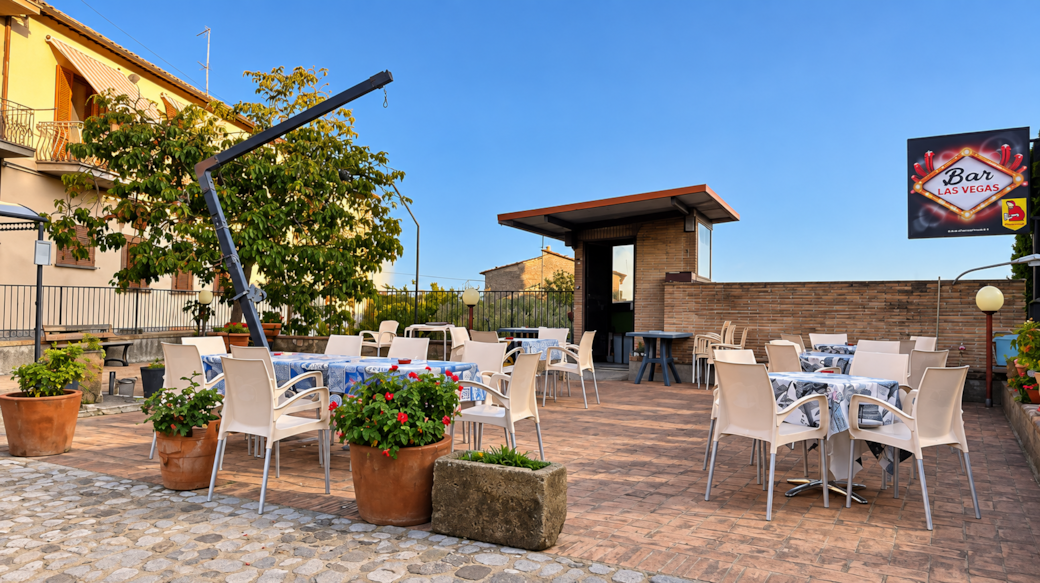
Bar Las Vegas — Meet Massimiliano (Max) & Jenny
Our wonderfully quirky local bar is run by our great friends Massimiliano (Max) and Jenny, who are every bit as individual and welcoming as their bar.
Las Vegas is one of the social hearts of Monterubiaglio. Stop for a morning coffee or breakfast, stay for a chat, or settle down later for one of their famously generous aperitivi.
One of our favourite spots is the bar’s little terrace and piazzetta, where you can sit outside with a coffee or a glass of wine and enjoy the view. It is the perfect place to slow down, watch village life unfold and very quickly start recognising familiar faces.
Massimiliano (Max) and Jenny also make pizza when ordered in advance. You can enjoy it there on the piazzetta or take it home with you. The bar is also becoming increasingly welcoming to cyclists, with e-bike charging facilities planned.
It is quirky, friendly and unmistakably Monterubiaglio — and one of the places where we hope you’ll begin to feel part of our village rather than simply a visitor passing through.
Sabatini — Our Village Shop, Grocery Store, Butcher & Cook
Andrea Sabatini is a wonderful butcher and cook, as well as a familiar face at the heart of village life.
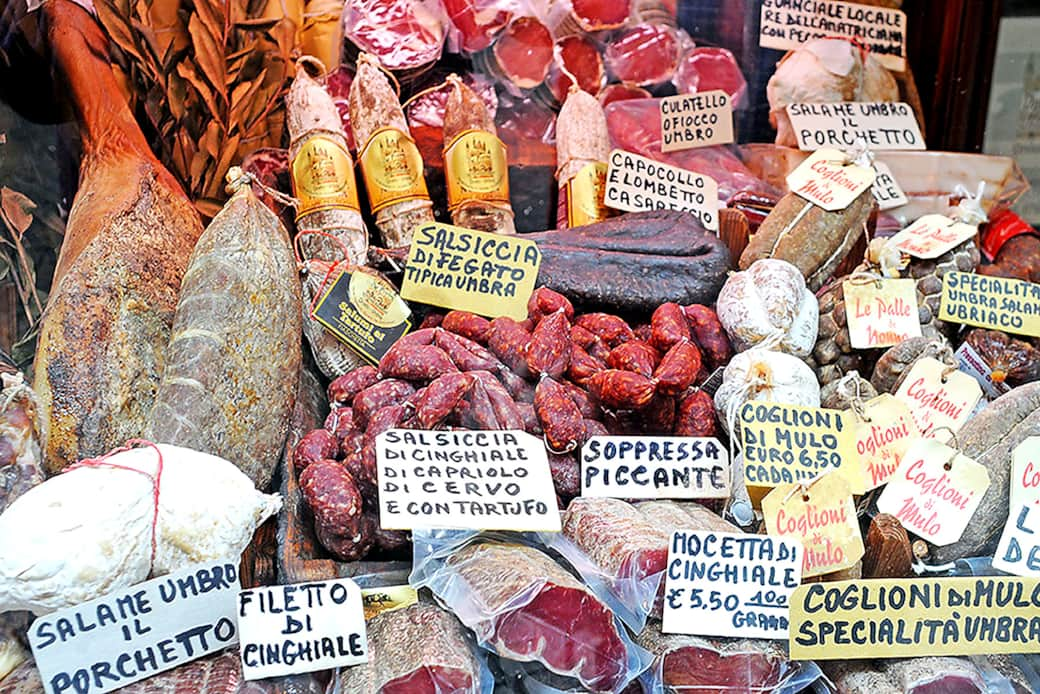
His family village shop and grocery store is one of those wonderful places where you can find far more than you might expect — fresh meat, cold cuts, cheeses, groceries and everyday household essentials.
Andrea can also prepare food to order. We can arrange something delicious to be waiting when you arrive, a meal for an evening when you don't feel like cooking, or a picnic to take with you while walking, cycling or exploring the countryside.
It is exactly the kind of small family business we love having on our doorstep — and shopping here is one of the easiest ways to support the community you are staying in.
Fresh Bread & Everyday Village Life
La Sorgente del Pane, our local bakery, means fresh bread and baked goods are available here in the village too — one of the small pleasures of everyday Italian life.
Families will also find a children’s playground and football/sports area, while the village has its own Post Office, currently open on Wednesday mornings.
So although Monterubiaglio is small, you can spend a surprisingly easy day without getting into the car — collect some fresh bread, call into Sabatini, have a coffee at Las Vegas, let the children play and return to the piazzetta for an aperitivo as the day draws to a close.
La Pergoletta Small Dining Room
Nearby — Castel Viscardo
Just a short drive from Monterubiaglio, Castel Viscardo has a wider selection of shops, places to eat and useful everyday services.
La Pergoletta
One of our favourite places to eat locally is La Pergoletta, a traditional family restaurant serving Umbrian cooking.
It is somewhere we genuinely enjoy ourselves and a lovely choice when you want a proper local lunch or dinner without travelling all the way into Orvieto.
Taproom Primo Contatto
For something a little different, Birrificio Primo Contatto is a local brewpub and taproom — a relaxed place to discover locally brewed craft beer and another small independent business worth seeking out during your stay.
Everyday Essentials
Castel Viscardo is also handy for the practical things you may need during your stay, with a pharmacy, bakery, Post Office, ATM, hairdressers and beauty services, including Giulia, our own local hairdresser.
Food Shopping & Supermarkets
One of the advantages of staying in Monterubiaglio is that you don’t necessarily need to begin your holiday with a trip to a large supermarket.
Between Sabatini — our village shop and grocery store, butcher and caterer — and La Sorgente del Pane, you can buy many of the everyday things you need right here in the village.
For a larger shop, head towards Orvieto. In the village of Allerona, you’ll find InCoop, a useful stop for a larger grocery shop while still retaining the feel of a small local supermarket.
Continue towards Sferracavallo and the choice becomes wider, with larger supermarkets including Famila Market and Lidl. Carry on into Orvieto and Orvieto Scalo and you’ll find an even broader range of supermarkets, specialist food shops and other everyday services.
For us, though, part of the pleasure of staying here is shopping locally when you can — buying bread in the village, choosing something good from Andrea at Sabatini and stopping at Las Vegas on the way home.
Come and Live Like a Local
What makes all of this special isn’t simply having useful things close to the house. It is the people behind them.
Stay for a few days, visit the same bar, collect your bread, call into Sabatini and say buongiorno to the people you pass.
Have an aperitivo with Massimiliano (Max) and Jenny, ask Andrea what’s good today, wander home through the old streets and listen for the bells that have marked the rhythm of village life for generations.
Don't worry if your Italian isn't perfect, either. A buongiorno, a smile and a willingness to have a go will take you a surprisingly long way.
Monterubiaglio begins to feel less like somewhere you are visiting and more like somewhere you belong.
That, for us, is what a slow stay is really about - La Dolce Vita in Monterubiaglio!
La Dolce Vita